
VALUE AVM is a valuation system for the German real estate market that combines statistical and standards-based methods. From an address — and, where available, further property data — it derives market values and mortgage lending values as well as purchase prices and rents: synchronously, transparently and in line with regulatory requirements. The system’s suitability for determining the comparative value under § 19(2) BelWertV (German Mortgage Lending Value Ordinance) has been confirmed by an independent expert opinion, and the software has been audited in accordance with IDW PS 880 (the German auditing standard for software).
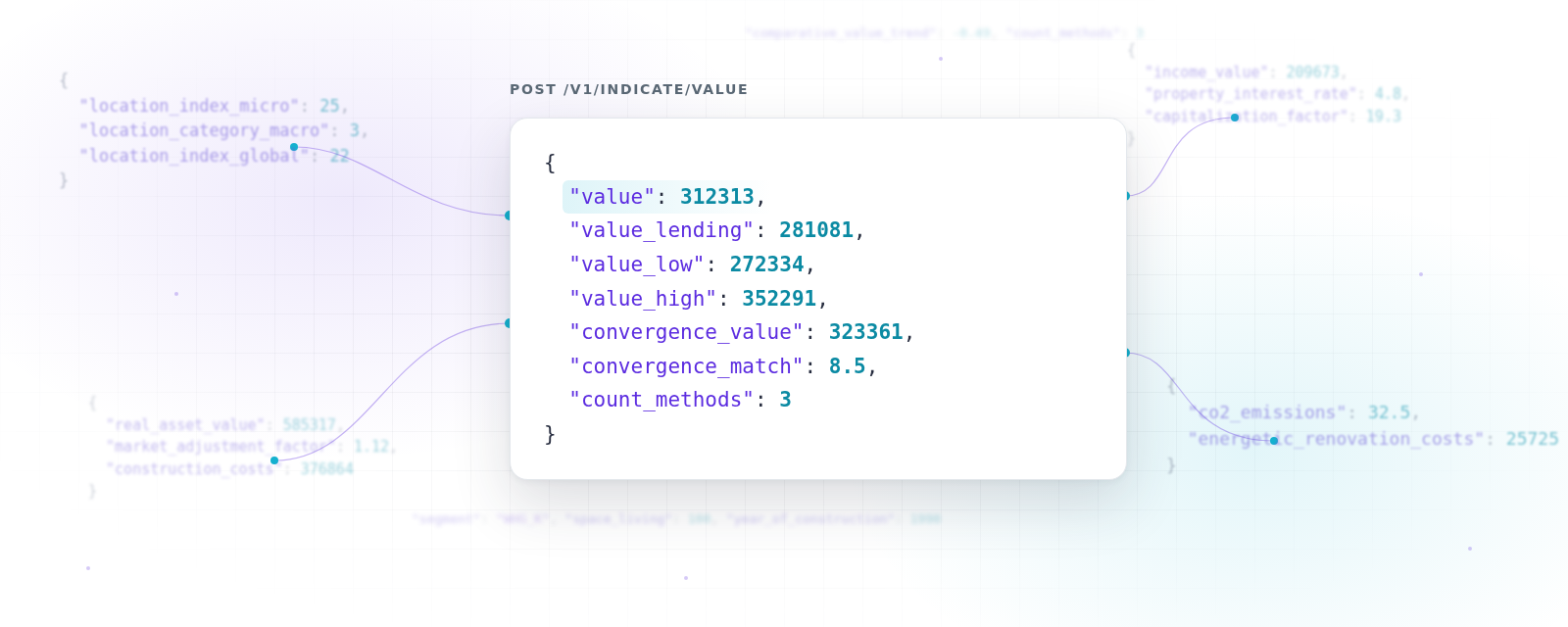
What the AVM needs
The AVM works with what is known. Address and segment are mandatory, plus a few core details per segment: for owner-occupied and rental apartments, living area and year of construction; for one- and two-family houses and multi-family houses, additionally plot area and building type; for undeveloped land, the plot area. The interface itself specifies which fields are mandatory for each segment at /v1/indicate/value/specification. All other variables are populated by the model with well-founded assumptions, each of which can be overridden individually. The more property data you add, the more reliable the valuation becomes — and the full model is calculated every time, not a simplified version.
When the model value is sufficient — and when it is not
For a large share of use cases, the model value is the decisive value and not merely a preliminary step. This applies to the ongoing monitoring and revaluation of real estate collateral, to portfolio and stock analyses, to preliminary checks in the application process and to pricing. The EBA Guidelines on loan origination and monitoring explicitly provide for the use of advanced statistical models for these purposes.
A stricter rule applies to the mortgage lending value. § 19(2) BelWertV permits the comparative value of one- and two-family houses and residential condominiums to be determined using computer-assisted, database-driven valuation models — the valuation itself is carried out by a competent person. The provision further requires that the suitability of the model be confirmed at least annually by a qualified body independent of the system and database provider. This confirmation is in place for VALUE AVM.
The situation is different for an auditable individual valuation — simplified under § 24 BelWertV or full under the Pfandbrief Act (PfandBG). As a rule, it involves a site inspection, a review of documents and an assessment by a human being. VALUE AG provides this service in the REVA valuation environment; the AVM supplies the values, the calculation path and the data basis, while professional responsibility for the valuation remains with the valuer. How a case is managed there, from the first indication to the final valuation, is described on the REVA page.
Three approaches, one convergence value
VALUE AVM calculates the approaches provided for by ImmoWertV (German Real Estate Valuation Ordinance) and BelWertV in parallel and brings them together. It works along two paths at once: statistically, where the data situation supports the value, and standards-based, where the regulations prescribe the calculation path.
- Comparative value — hedonic regression, supplemented by real comparable properties selected via a similarity measure. Leading approach for owner-occupiable condominiums; for one- and two-family houses the cost approach leads, with the comparative value calculated in parallel.
- Income value — capitalisation of the sustainably achievable income using the property yield (capitalisation rate). Standard approach for investment properties.
- Asset value (cost approach) — land value plus construction costs less age-related depreciation, with market adjustment.
- Convergence value — the automatically weighted overall value from comparative value, comparative price and the leading approach (asset value or income value). It is a model value and does not replace the appraisal of the individual results by the expert. The extent to which the value ranges of the approaches overlap is also reported as the convergence match in per cent — the higher it is, the more the approaches agree. It thus serves as a built-in confidence signal.
The comparative value is the statistical path: it is derived from observed market activity in a data-driven way. The asset value and income value, by contrast, follow the standardised calculation paths of ImmoWertV and BelWertV with their prescribed inputs — normal construction costs, construction price index, regional and market adjustment factors, standard land values, rent assumptions and property yields. The AVM derives market adjustment factors and property yields from its own models. Both paths are fully implemented; segment and data situation determine which one leads.
Because several approaches calculate independently of one another, the result is robust: if only a few property characteristics are known, the approaches support each other.
Market value and mortgage lending value
The two types of value are not two levels of accuracy of the same value, but two distinct value concepts. The market value relates to a specific valuation date and reflects the price achievable on that date. The mortgage lending value follows § 16(2) of the German Pfandbrief Act (PfandBG) in conjunction with BelWertV: the sustainably achievable value, independent of temporary market fluctuations and speculative elements, derived under the minimum assumptions prescribed there.
How the mortgage lending value is determined depends on the approach. In the model-based comparative value approach, the system calculates it by applying a relative safety discount to the model value — preset to the minimum discount of 10 % under § 19(1) BelWertV, which can be increased for each case, and the response explicitly states the discount applied. In the income and asset value approaches, no flat-rate discount is applied by default: there, the model uses its own mortgage lending value inputs — capitalisation factor and property yield, sustainable rent, management and modernisation costs — each of which can be set separately from the market value path. For the asset value, the sustainability factor caps the mortgage lending value at a maximum of 90 % of the market value; a flat-rate discount can optionally be set. The gap between the two types of value therefore depends on the approach and is not constant.
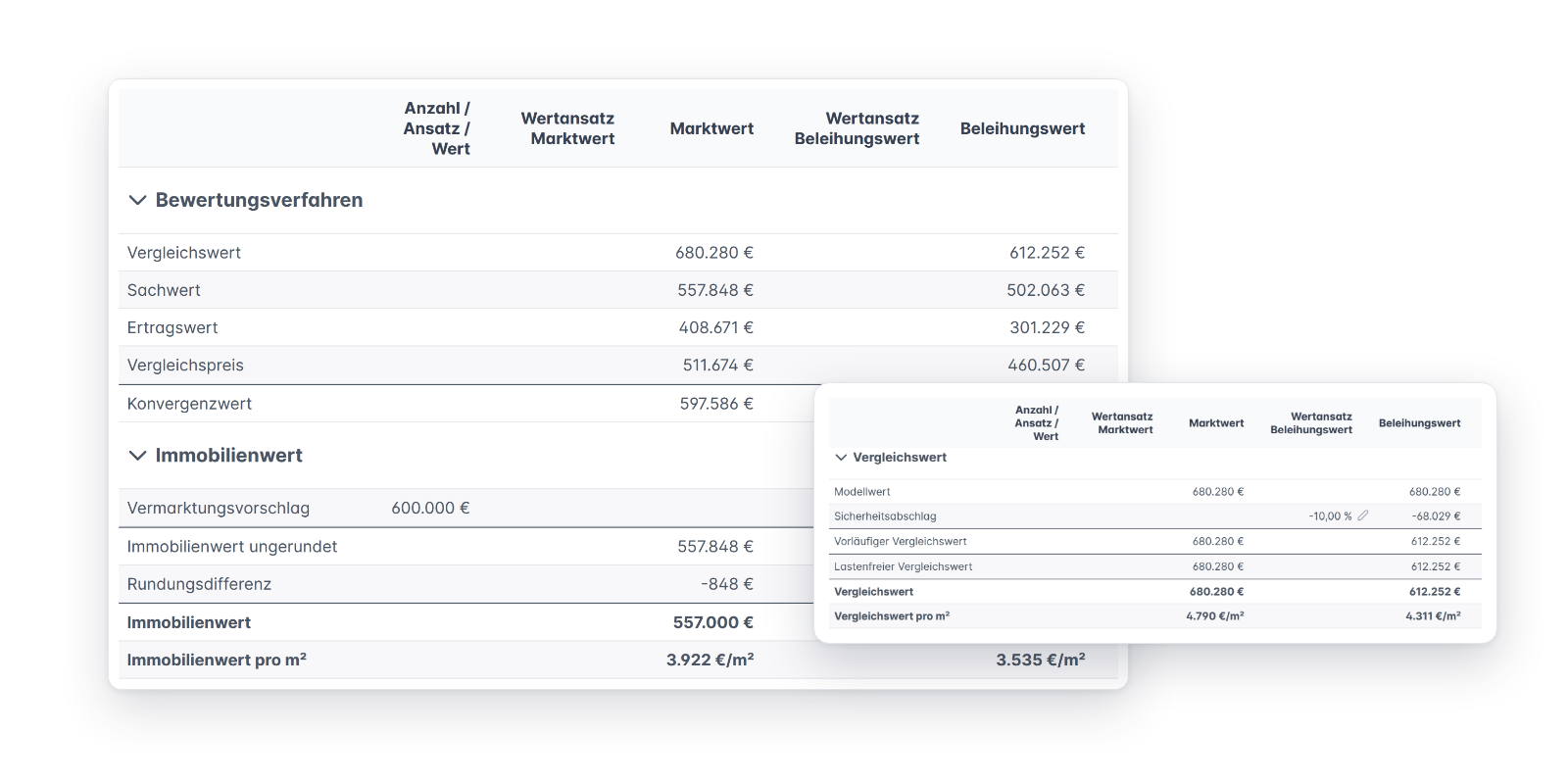
Along with the market value, the model supplies the range (value_low/value_high), the convergence match as a measure of how strongly the value ranges of the individual approaches overlap, and the respective leading approach. Where the data situation does not support a statement, the system issues a notice instead of reporting a precision that the data basis cannot provide.
Data basis
The AVM draws on two data streams. At its core are transaction data from the financing process — real purchase prices, recorded by experts, valuers and bank staff. These are supplemented by the VALUE market database, which supports the model parameters without setting the price level.
The scope, origin and quality assurance of the data are extensively documented, and an internal validation report is presented regularly. What matters for the valuation is the external benchmark: at the level of spatial planning regions, the price data closely match the analyses of the official local valuation committees (Gutachterausschüsse) in structure and level — evidence that the price level is close to the market, not of accuracy in an individual neighbourhood. In addition, the valuation data and standard land values of the local valuation committees are incorporated.
Accuracy — measured against real prices
Model quality is not measured against the model itself, but against prices actually paid. The comparative value approach calculates using 649 segment- and region-specific sub-models, which are regularly tested against real purchase prices in a cross-validation. In addition, we continuously compare the model values with the final bank values set in practice.
The results per segment, with typical deviation and hit rate, are published in the annual validation report. We provide the report to institutions and auditors on request; for customers with access credentials, it can also be retrieved by machine via the interface at /v1/validation.
Compared with actual purchase prices, the mean deviation for one- and two-family houses and condominiums is close to zero: the model neither systematically overvalues nor undervalues.
Because quality varies regionally, the AVM provides it with every single valuation. With modelMetrics=true, the response contains the metrics of the sub-model that calculated this property:
- Cross-validation — typical and mean percentage deviation (MDAPE, MAPE, SMAPE, RMSPE), deviation in euros (MDAE, MAE), forecast standard deviation (FSD) and the share of cases within ± 10 % and ± 20 % (Q10, Q20).
- Model quality — coefficient of determination (R², adjusted R²), residual standard error, AIC, BIC, deviance, degrees of freedom and p-value, plus model type and model region.
- Data basis — observation period, number of cases, share of transaction data and of the cross-validation, mean living area and the highest building age in the data.
This way, every user can see how well the model performs in precisely this region — instead of a nationwide average.
Where the model is weaker, we say so: multi-family houses and residential/commercial buildings are more heterogeneous and traded less frequently, so the dispersion there is correspondingly greater. There is no separate cross-validation for land. In both cases: the thinner the comparable market, the more important the reported value range — and the more likely it is that a professional review is needed.
Independently audited
- Suitability under § 19(2) BelWertV — an expert opinion by the Real Estate Research Institute (RERI) at ISM International School of Management confirms the suitability of the valuation system for determining the comparative value of one- and two-family houses and residential condominiums. The provision requires this confirmation at least annually by an independent qualified body. First prepared in 2024, most recently updated in December 2025 with an unqualified result.
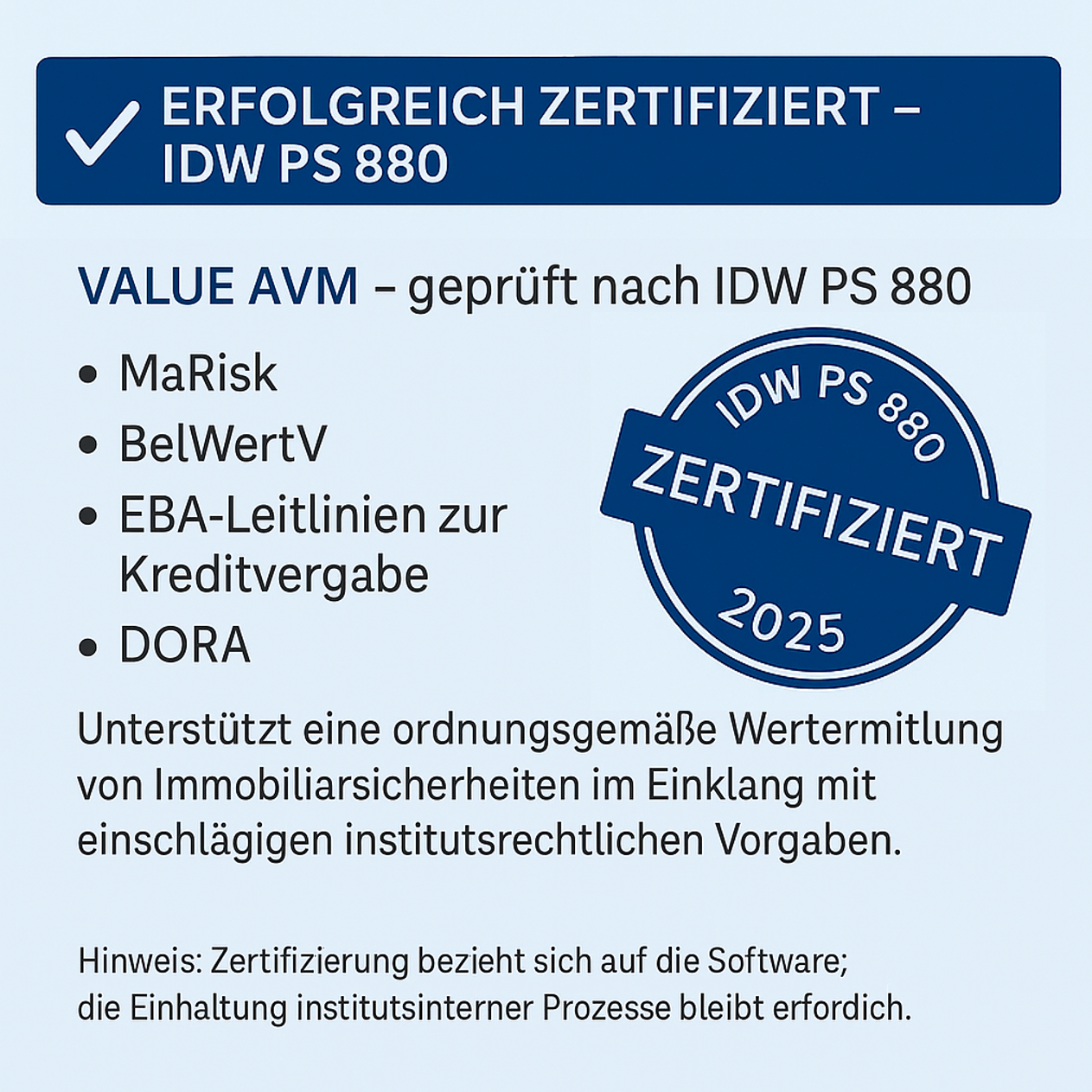
- IDW PS 880 — an audit firm has audited the software and confirmed its compliance. The audit context comprised MaRisk (German Minimum Requirements for Risk Management), BelWertV, the EBA Guidelines on loan origination and DORA.
- Information security — operations and the server environment follow a management system certified to ISO 27001.
From the suitability opinion: “In summary, it can be concluded that the suitability of VALUE AG’s valuation system within the meaning of § 19.2 BelWertV is fully given. This applies in particular to the scope and quality of the data set used and to the methodology applied.”
And the necessary context: the VALUE value indication is a model-based method. It replaces neither experts nor a valuation report — it supports the valuation and financing process efficiently and transparently.
How quality is maintained
Testing takes place on four levels: data, model, software and operations. The data undergo outlier removal, duplicate detection and plausibility checks at the level of individual cases. The models are cross-validated and continuously backtested. Before each release, automated tests are run, including ten thousand randomly drawn test valuations per integration test. Updates follow a fixed six-week cycle.
Release notes and documentation
New data and model versions appear first on the NEXT test environment and one week later in production. Releases are published only once all quality checks have been passed. Each release comes with release notes:
- Dates — the most recent and upcoming releases on NEXT and in production, so you can plan tests and acceptance.
- Data basis — which period is included (always the last five years) and how case numbers have changed compared with the previous release.
- Interface changes — new variables per endpoint and segment as well as scheduled changes: variables that will be discontinued are announced early together with their successor, so you can adapt your integration in good time.
- Value development — how the values of a fixed standard portfolio and of a reference property per segment have changed compared with the previous release. This shows what a new data version means for your own portfolio.
The documentation also includes the complete documentation of the AVM, a method description for each approach (value indication, comparative value, comparative price, asset value, income value, energy performance, residential locations and time series), the parameter overview in German and English, and the validation report. All documents belong to the respective release and can be retrieved via the interface (/v1/releasenotes, /v1/documentation, /v1/parameters, /v1/validation and, for each approach, …/documentation); in REVA, the method description is available directly in the tab of the respective approach.
One call, one response
The AVM is accessed via a REST interface. In the simplest case, the request consists of the address, the segment and the segment’s mandatory details, such as living area and year of construction; the address is geocoded, which fixes the location. The response arrives in milliseconds as JSON — with market value and mortgage lending value, value range, the results of the individual approaches and plain-language notes. Every input can be overridden with a value of your own.
POST /v1/indicate/value{
"address": "Hansestraße 14, 23558 Lübeck",
"segment": "WHG_K",
"space_living": 100,
"year_of_construction": 1990
}roundResults=true){
"value": 312313,
"value_lending": 281081,
"value_low": 272334,
"value_high": 352291,
"comparative_value": 312313,
"income_value": 209673,
"convergence_value": 323361,
"convergence_match": 8.5,
"info_info_de": "Wohnung wird als eigennutzungsfähig eingestuft. / Konvergenzwert basiert auf Vergleichswertverfahren (C). / …"
}value is the market value according to the leading approach for this property, convergence_value the value weighted across all approaches calculated; convergence_match states in per cent how strongly the value ranges of the individual approaches overlap — the higher it is, the more the approaches agree.
The approaches and their endpoints
Each AVM module can be called and licensed individually — or bundled as a complete solution that calculates all approaches and combines them into the convergence value.
- Complete solution
/indicate/value— market value with range, mortgage lending value, convergence value and convergence match, leading approach and plain-language notes; plus financing details such as loan amount, unsecured amount and unsecured share. - Comparative value
/indicate/comparativeValue— hedonic regression, supplemented by real comparable properties; plus market rent and in-place rent, multiplier, local and regional price trend, marketing period and the model metrics (see above). The safety discount for the mortgage lending value can be adjusted for each case. - Income value
/indicate/incomeValue— capitalisation of the sustainably achievable income with property yield including range, residential and commercial rents, rent loss risk, management costs and land value; for investors, additionally the value at risk. - Asset value
/indicate/realAssetValue— land value plus construction costs less age-related depreciation, with market adjustment factor including range, construction price index and regional factor; all interim calculations are included. - Rental value
/indicate/valuewith segmentWHG_M— market rent for apartments; the in-place rent, taking the tenancy duration into account, is provided by the comparative value. - Asking price
/indicate/comparativePrice— indication based on the best comparable listings, with the number of listings used. - Energy and CO₂
/indicate/energyValue— energy performance indicators, CO₂ emissions and refurbishment costs from a database of more than 7 million energy performance certificates. - Location
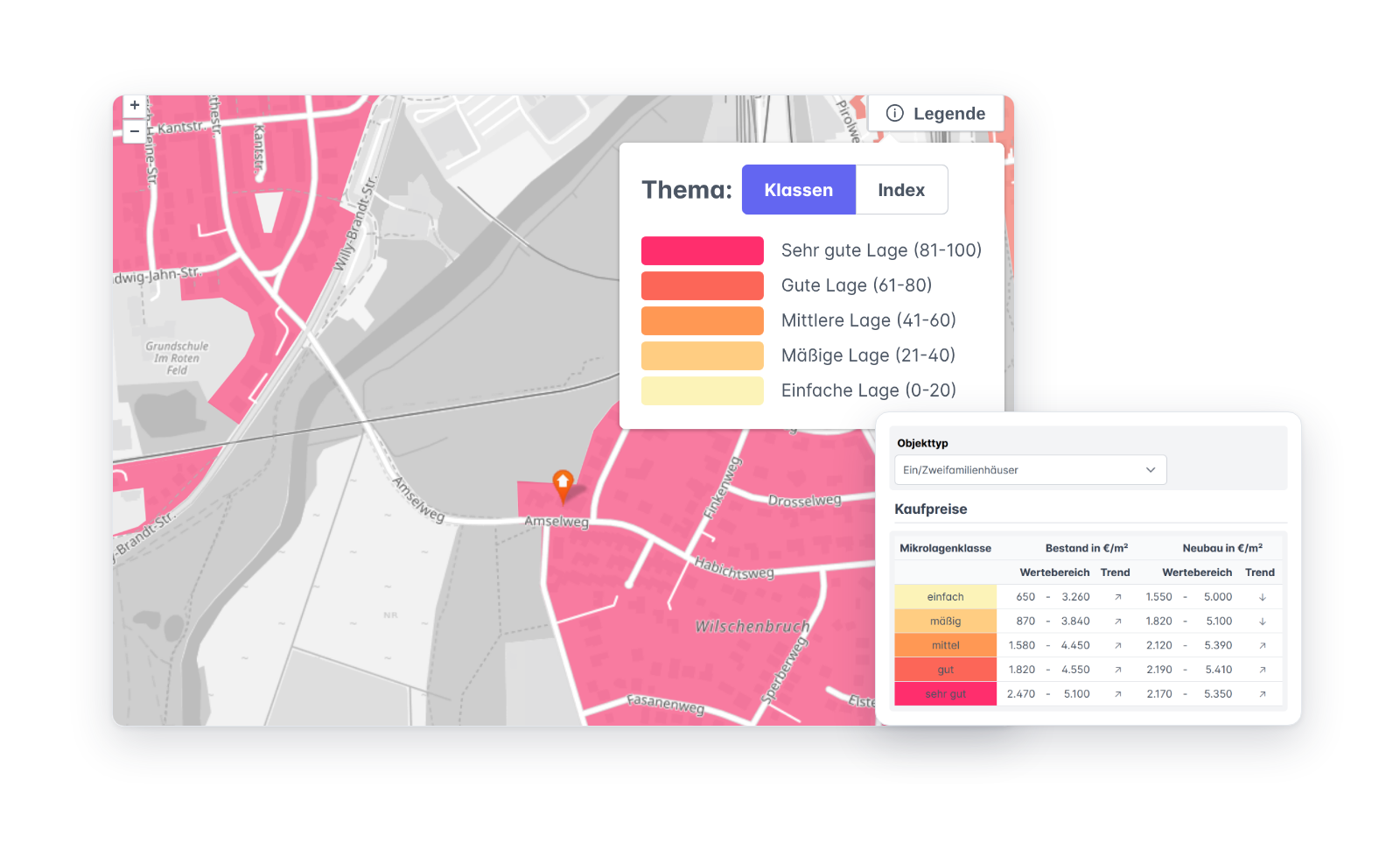
/locationInformation/microMacro— micro, macro and overall location as an index and as a class; plus dedicated endpoints for standard land values, noise, climate risks, emissions, points of interest with travel times, neighbourhood, municipality type, price index and price time series including marketing period, as well as a textual location description. - Property characteristics according to NHK
/objectInformation/…— building category, degree of modernisation and quality of fittings derived from individual characteristics. - Address resolution
/georef— free-text address to coordinates, with an indication of match accuracy.
How to use the AVM
The AVM can be accessed via the REST API, used in the REVA valuation environment and is integrated into platforms such as Europace and Genopace with BaufiSmart, where the valuation is produced directly within the ongoing loan process. The portfolio overview shows which route suits which use case.
For systems and AI agents
VALUE AVM is built as an interface, not as a user interface with an API attached. Everything a person can retrieve, a system can retrieve too — including the supporting evidence. The interface is self-describing: each endpoint comes with a machine-readable specification and a method description.
- Base —
https://avm-api.value-marktdaten.de/v1/, OpenAPI 3.1 at/v1/openapi.json, JSON over HTTPS, authentication via HTTP Basic. - Segments — condominium (
WHG_K), one-/two-family house (EZFH_K), multi-family house and residential/commercial building (MFHWGH_K), land (GRST_K) and rental apartment (WHG_M); the mandatory details per segment are provided by/v1/indicate/value/specification, and each additional parameter out of around 190 refines the result. - Evidence, retrievable by machine —
/v1/validationprovides the validation report (with access credentials),/v1/documentationthe complete documentation,/v1/parametersthe parameter overview,/v1/releasenotesthe changes per release and/statusthe operating status including data version.
This allows the AVM to be plugged into an agent as a tool: the agent reads the specification, calls the valuation and can deliver the method along with the result. Details on all interfaces and the MCP server can be found under APIs & AI agents.
Frequently asked questions about VALUE AVM
How accurate is VALUE AVM?
Accuracy is measured against real purchase prices and against the bank values set later — not against the model itself. The metrics per segment are published in the annual validation report, which we provide to institutions and auditors on request. For heterogeneous properties such as multi-family houses, the dispersion is greater; the reported value range indicates this in each individual case.
Who audits the AVM independently?
Two bodies: an independent suitability opinion under § 19(2) BelWertV — it assesses the model’s suitability for determining the comparative value and was most recently updated in December 2025 — and an audit firm that has audited the software in accordance with IDW PS 880.
What are the values based on?
On real purchase prices from the financing process, recorded by experts and bank staff, supplemented by the VALUE market database. Not on self-assessments by sellers.
Which approaches does the AVM calculate?
The comparative value, income and cost (asset value) approaches under ImmoWertV and BelWertV, combined into the convergence value, plus rent and energy performance indications.
Does the AVM replace a valuation report?
No. It is a model-based method and replaces neither experts nor a valuation report. An auditable valuation — simplified under § 24 BelWertV or full under the Pfandbrief Act — is as a rule carried out with a site inspection and document review in REVA.
Who is the AVM intended for?
For credit institutions, valuers and appraisers, portfolio holders and anyone who needs property values in large numbers and in a transparent way.
Would you like to evaluate VALUE AVM? Get in touch — we will set up a test account for you and provide you with the validation report and audit documentation.